Super Bartie: what I built around my CDC engine
A follow-up to Bartie. I added an API for checking on the pipeline, a second destination that stores vectors, an MCP server, and a deployment.
Super Bartie is a follow-up to Bartie, the small Postgres CDC engine I built to understand how Artie works. Bartie ran from a terminal. For this version I left the reader and writer alone and built the parts around them: an API for checking on the pipeline, a second destination that stores vectors, an MCP server, and a deployment I can link to.
See it run
Try it
On the live demo you can watch rows get replicated, change a row yourself, pause the writer, and ask questions about the data. The second page shows the source and destination next to each other.
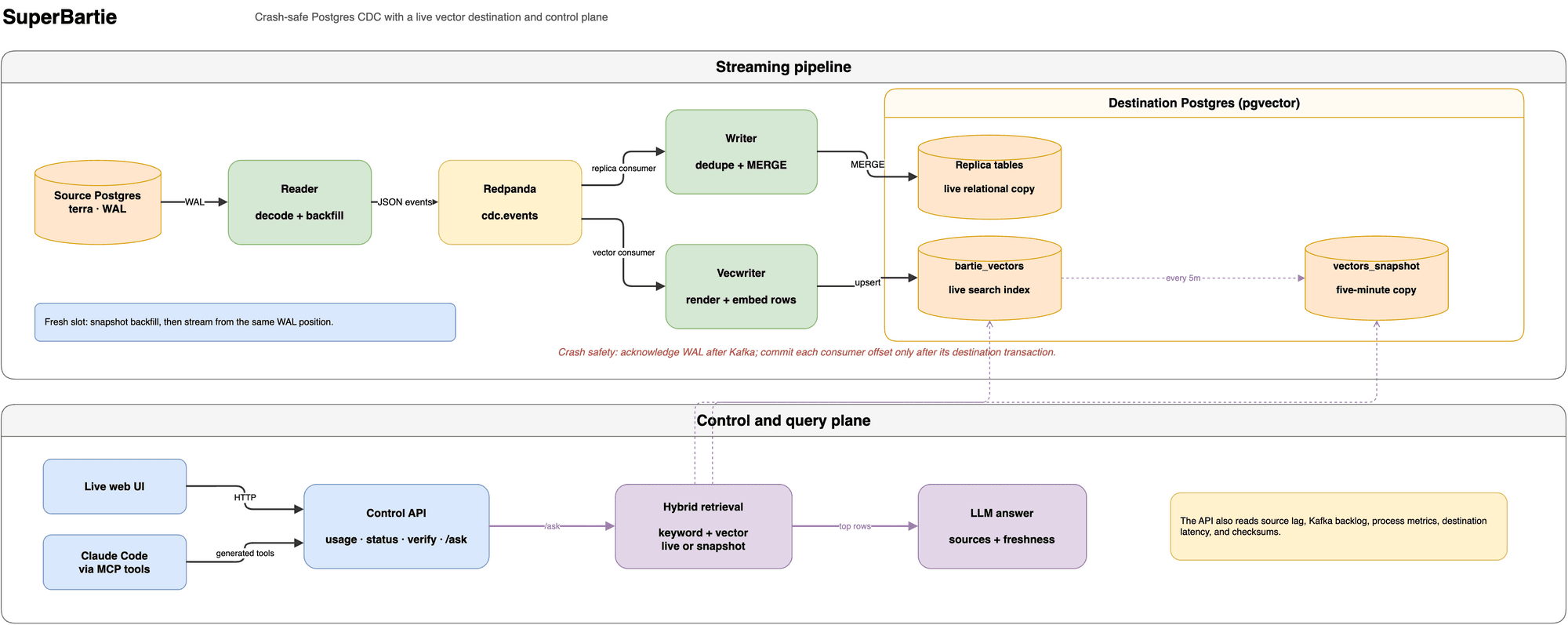
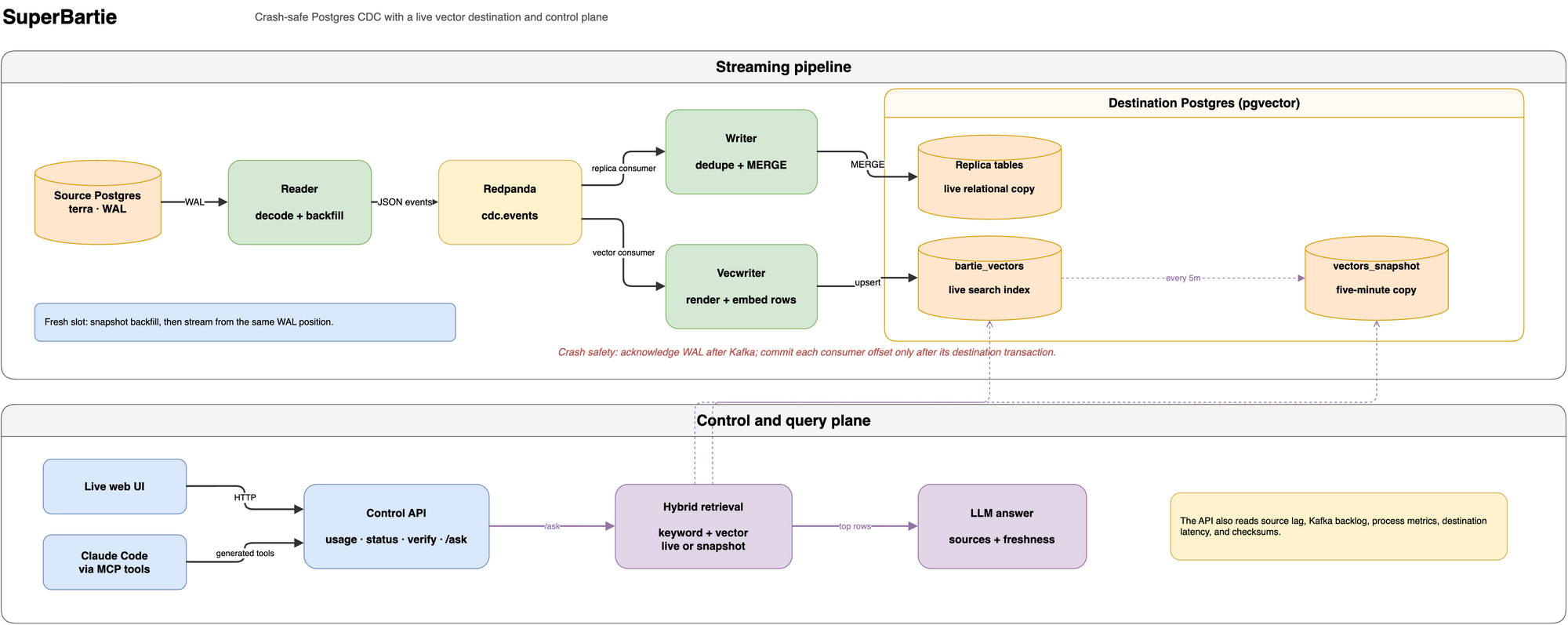
How it fits together
What I added
1. An HTTP API
With Bartie, the only way to see what was happening was to read logs. I added an HTTP API so the pipeline can be checked and controlled from outside:
| Endpoint | What it does |
|---|---|
| Status | Whether the pipeline is running or paused, which tables it copies, and which processes are up |
| Usage | Latency per table, plus reader lag, backlog, and merge time, which show which part is slow |
| Error log | What failed and in which process |
| Verify | Compares checksums of every table in both databases |
| Pause and resume | Stops and restarts the writer |
I copied the URL layout from Artie's public API, so the two are easy to compare.
2. A second destination for vectors
I added a second consumer that reads the same Redpanda topic as the writer. For each changed row it builds a sentence, embeds it, and stores it in pgvector. The idea came from Artie's post on real-time data for AI.
The demo keeps two copies: the live table, which is about two seconds behind the source, and a snapshot that refreshes every five minutes. If you change a row and ask the same question against both, only the live copy has the new answer.
3. An MCP server
Artie's MCP server generates its tools from an OpenAPI spec instead of defining each one by hand. I built mine the same way with a spec for my API and used their tool names where the endpoints matched.
I also added two tools they do not have. pipeline_verify compares checksums of every table in both databases, and destination_ask searches the vector table.
Running it
Everything runs with Docker Compose on one VM: the source Postgres, Redpanda, the destination Postgres with pgvector, and the Go binaries. Caddy handles TLS. A cron job resets the data every night, which also means the backfill runs from scratch once a day.
The code is on GitHub: Super Bartie, and the engine it is built on, Bartie.